
Introduction by Meadow Arts
We are delighted to be part of Ode to the Midlands (OttM), a major new cross-regional programme led by CVAN West Midlands and CVAN East Midlands, investing in artists, organisations and audiences across the Midlands through digital contemporary art.
The programme brings together six organisations across the East and West Midlands, each working with a commissioned artist to create an ambitious new digital artwork exploring the cultural, historic and geographical identities of the Midlands. OttM is funded by the National Lottery through Arts Council England.
We’re working with visual artist Andy J Harper to develop a new commission. Andy is now well underway with the early stages of research, development and experimentation.
Andy works with light, sound and responsive systems to create immersive spatial installations. For Ode to the Midlands, he is testing ideas and exploring the possibilities offered by digital and responsive technologies and the use of textile such as lace. This process of investigation and discovery will help inform the direction of the new commission as it develops.
Read Andy’s diary entry/blogpost to find out more about the early stages of his Ode to the Midlands commission.
We’ll be sharing more from Andy and the development of the commission over the coming months.
Blog Post by Andy J Harper
When I was first offered the OttM commission, I had an idea.
That’s the slightly dangerous bit.
I could describe it. I could talk about lace, absence, breath, light and the textile history of the Midlands. I could imagine a suspended environment that people would move through.
On paper, it made sense.
Then I had to actually make it.
Over the last few months, I’ve been trying to work out what those ideas mean when they become physical things.
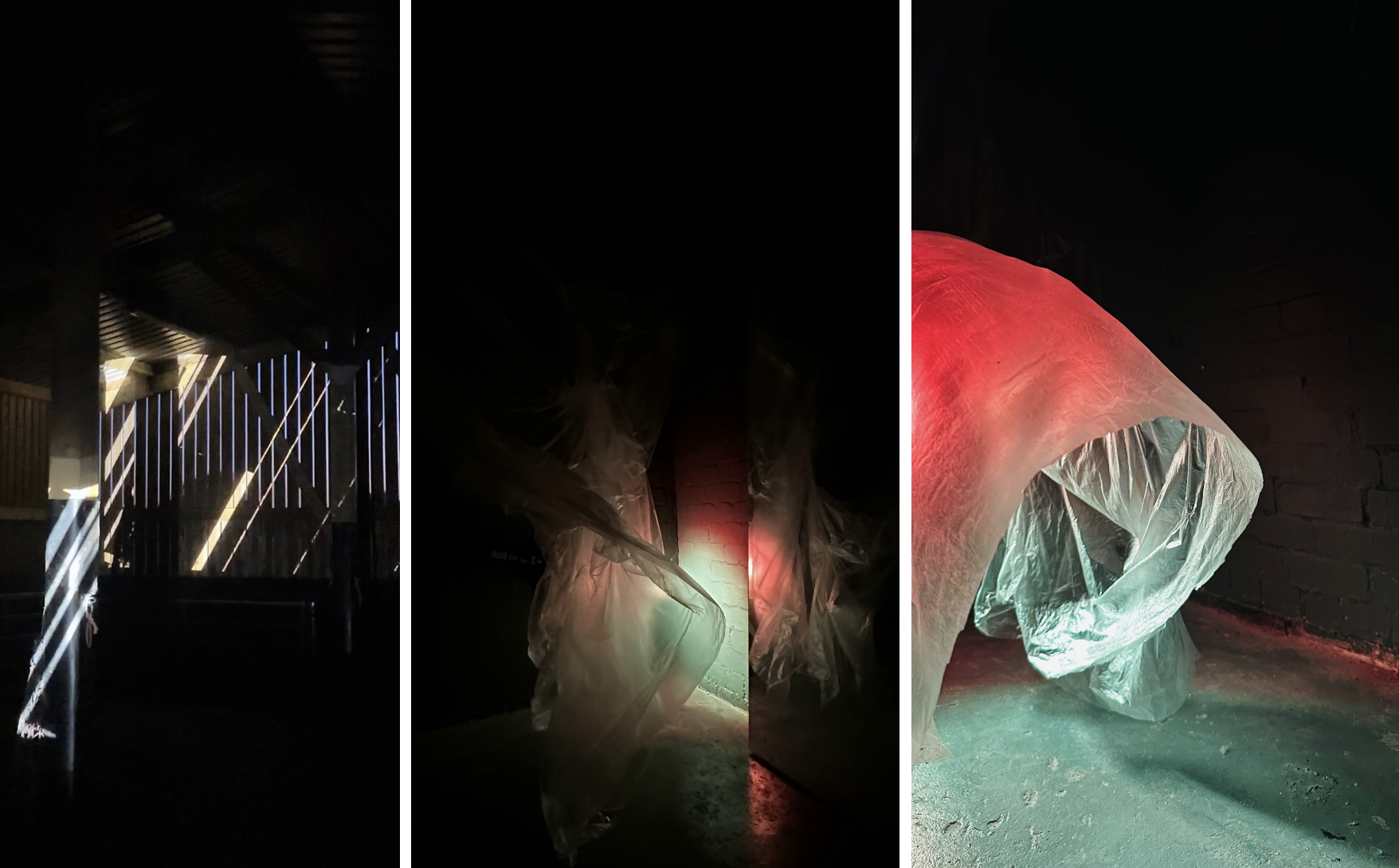
I built a small LAB at Redmile. A dark little space where I can experiment without having to know what I’m doing yet. It has slowly filled up with fabric, lights, mirrors, fans, cables and bits of material. I’ve been making things, photographing them, pulling them apart and making them again.
And quite a lot of it hasn’t worked.
I built a high-pressure misting system because I was interested in making air visible. I imagined light passing through fine water particles and creating a kind of living volume in space. It looked beautiful, but it also produced a lot of water, which became a fairly obvious problem when I started thinking about putting the work inside a historic textile building.
So that idea definitely isn’t going into any of the venues I’ve been shown, all of which are heritage spaces.
At first, that felt like a failure.
But I’m beginning to think that this is actually what the process is supposed to be. The mist answered a question: what happens if I try to make atmosphere physically? The answer was that something interesting happens, but perhaps not in this way.
So I tried fog. Then fabric. Then light. Then mirrors. Then more fabric.
I’ve been working with a lightweight 30 micron material. It isn’t glamorous, but it does something very interesting. Light passes through it. It diffuses colour. It disappears when the light changes. It folds. It catches air. It’s so thin, it can become almost nothing, and then suddenly become a large glowing form.
I’ve started heat-joining pieces together, trying to make larger structures. The joins aren’t particularly elegant yet. Sometimes I melt the material rather than joining it.
But occasionally something happens.
A shape appears.
Recently I made something that started to resemble a tunnel. That was exciting because suddenly I wasn’t making something to look at anymore. I was making something you might be able to enter.
That feels much closer to where I thought this project might go when I first wrote the proposal.
The original idea came partly from lace. I was interested in the fact that lace is defined not just by its threads, but by the spaces between them.
The absence is part of the material.
I’ve been thinking about that a lot while making these tests: the gaps in the fabric, the gaps in the hay barn, light passing through, air passing through, people moving through.
I’m beginning to realise that perhaps the work isn’t really about fabric at all.
It’s about what happens in the space between things.
And there is another layer to all of this that I don’t always talk about.
Being an artist can feel like a strange way to make a life.
There are times when I feel like a failure for not providing in the way I imagine I should. Not bringing in a predictable income. Not necessarily being able to point to something tangible and say: this is what I’ve produced, and this is what it’s worth.
I think that sits particularly heavily with me as a man and as a father. There is a deeply ingrained idea that I should be providing and protecting.
Sometimes I question whether what I’m doing is actually valid. Whether it’s important. Whether anyone cares. Whether I would be better off doing something more straightforward, providing a service that people actually need.
And then I come back to making.
I don’t create because I think art is some kind of therapy. It’s more fundamental than that.
Making is one of the ways I make sense of the world.
I don’t necessarily know what I’m thinking before I start. Often I only discover it through the process of trying something, getting it wrong, changing it and trying again.
That process of trial and error feels incredibly important to me.
Perhaps because it mirrors life.
Things don’t always work. Things change. We lose things. We start again. We discover something we couldn’t have predicted.
At times in my life I’ve found myself wanting things to be stable. Consistent. Comfortable. Easy.
And increasingly I’m wondering whether that’s the problem.
Nature doesn’t work like that. Everything is moving. Changing. Growing. Breaking down. Re-forming.
Meister Eckhart wrote that the universe is in a constant state of creativity. I’m not sure I fully understand what that means, but I recognise something in it.
When I’m making, I feel connected to that process of constant change. I’m not trying to hold something still. I’m allowing something to emerge.
And perhaps that is why I’m becoming increasingly interested in making environments that move and change rather than things that simply sit there.
The fabric moves. The light changes. The air moves through the space. The person enters. The work responds.
I still don’t know exactly what I’m going to make at the Flaxmill.
For once, I think I’m comfortable with that.
The commission has given me something I don’t often give myself: permission to not know.
To try something.
To fail.
To try something else.
And to see what emerges.